There are posts all over social media assigning weight values to springs. Sometimes they offer a single number, sometimes a range. But I have yet to find one that's accurate.
Look, I get it. We would love to have a number to assign each spring we use. It might make it feel easier to connect to the movement because we use specific weights in the gym.
But springs aren't like free weights. They are governed by Hooke's Law, which states that the more you stretch them the heavier they get.
At any two points in a movement, the spring may be offering different resistance!
What complicates this further is that springs are not standardized across major Pilates brands.
So today let's actually compare them. I charted every spring from six common reformer brands and lined them up against each other. What came out is the best argument I know for why understanding the physics matters more than memorizing a setting.
A spring is a slope, not a number
Here is the one idea that changes how you read every spring chart: a spring's resistance is not a single value. It is a line that climbs as the spring stretches.
The model is simple:
Force = k x + b
- Force is how much resistance it takes to stretch the spring that far. Or, you might call it how heavy the spring is at that point. You see this on the y-axis of the graph.
- b is the starting tension, the load the spring already pulls before the carriage moves.
- k is the rate, how fast the load climbs for every inch the carriage travels out.
- x is how far the spring is stretched, which depends on the movement and the machine. You see this on the x-axis of the graph.
Every brand draws its own lines
Five of these brands provide published data on each of their reformer springs. I've graphed them below. Gratz does not, and when I asked them I got no response. So I'm sharing my measurements of two new Gratz reformer springs.
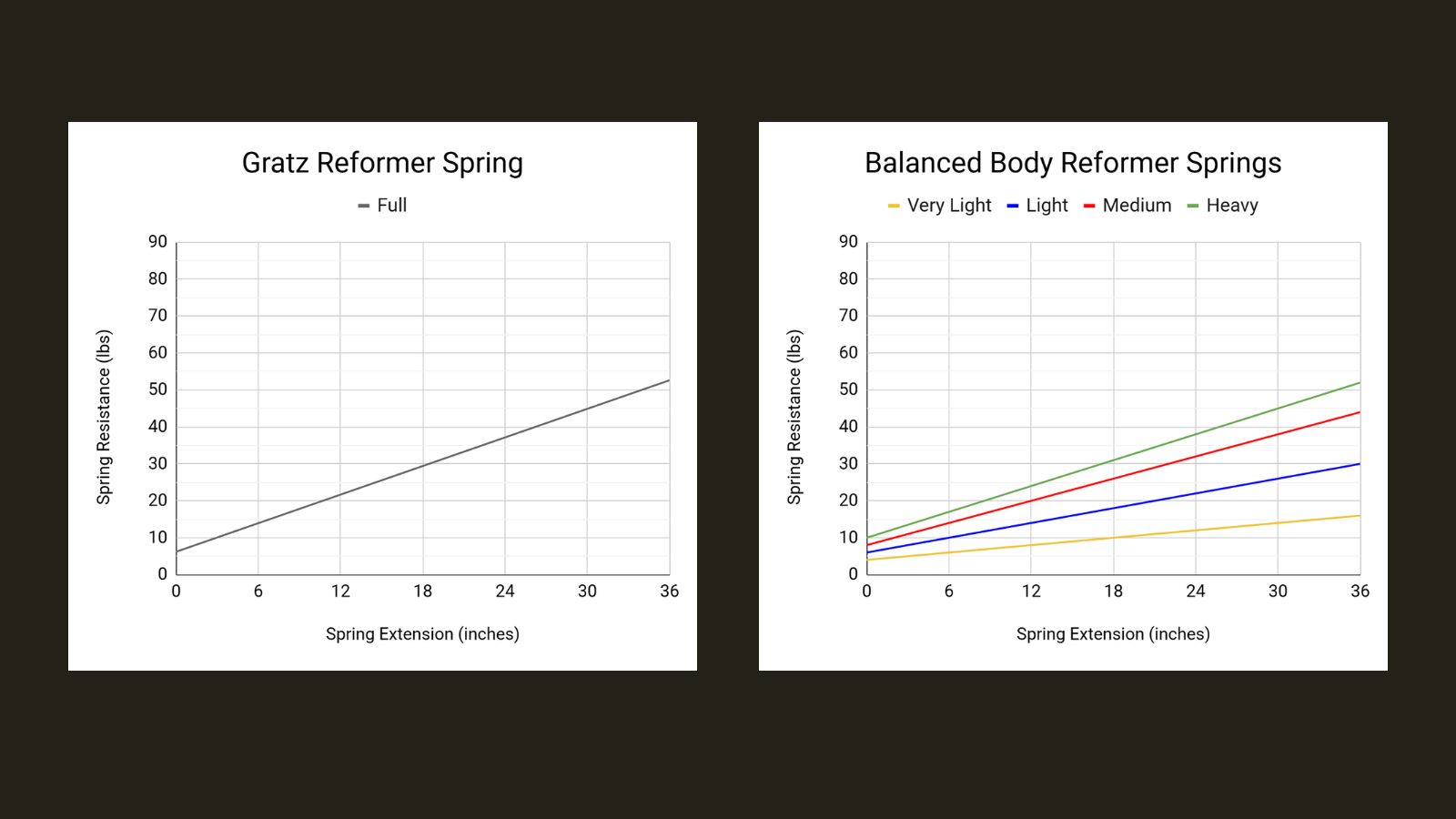
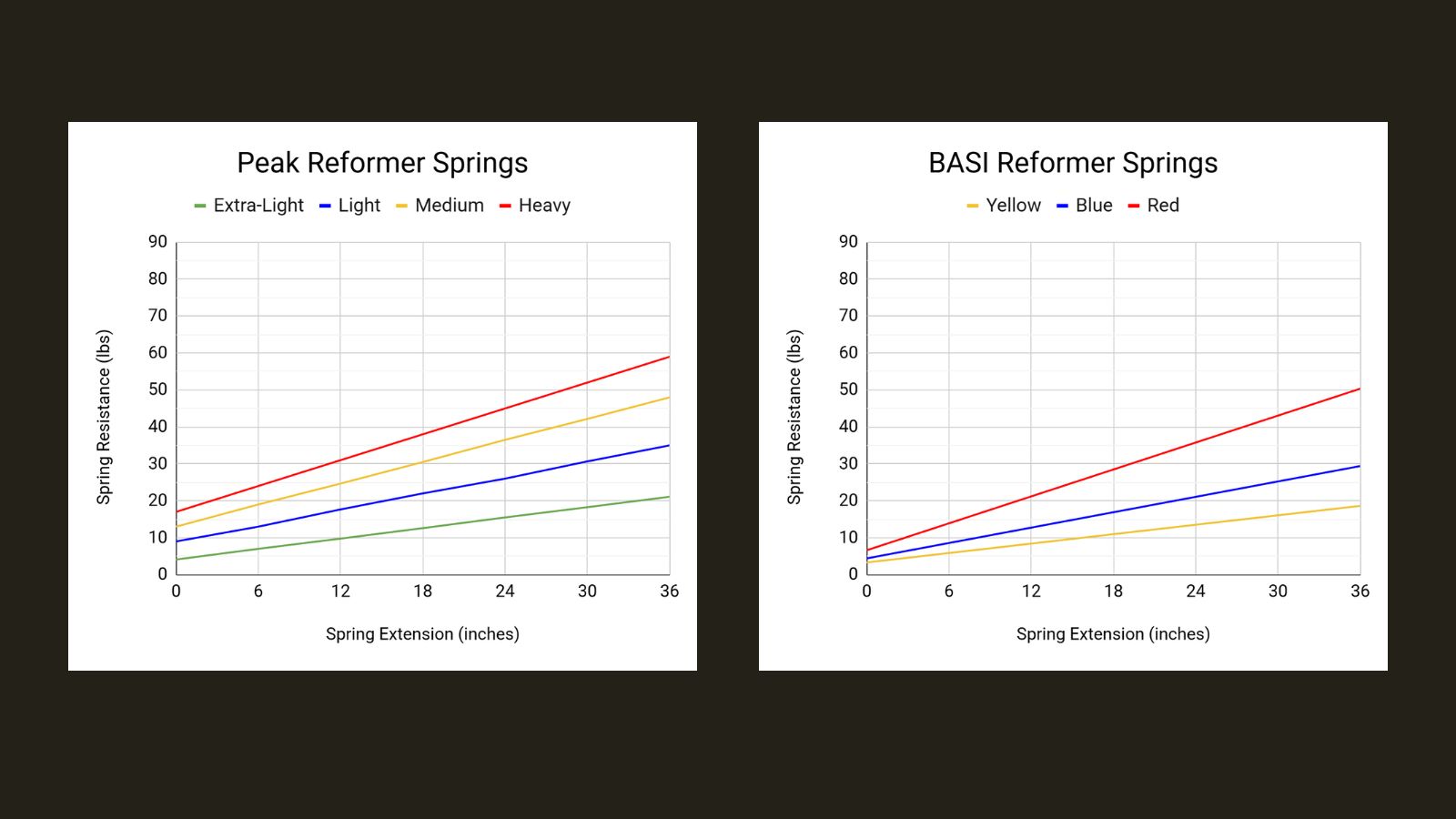
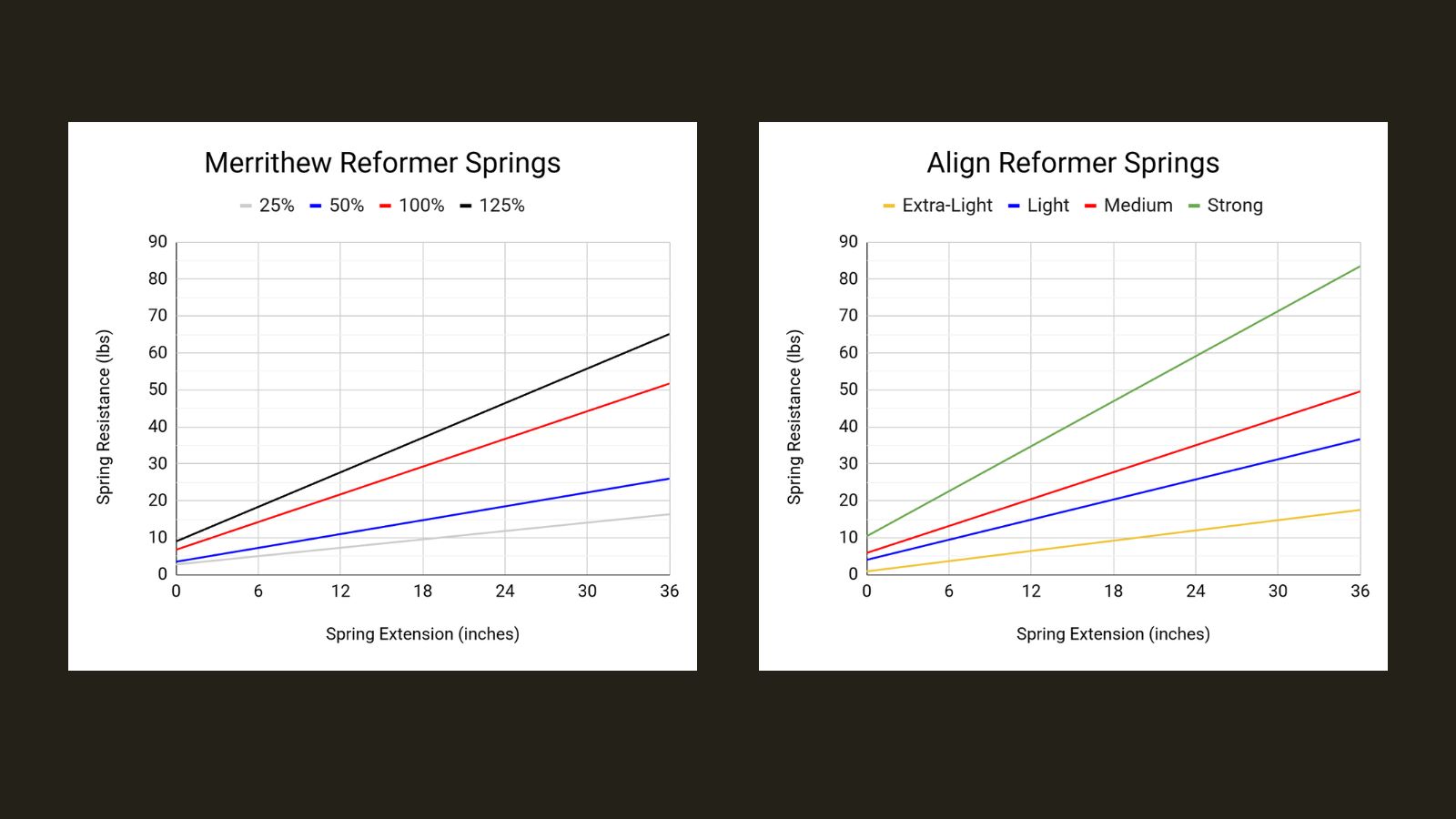
How do they compare?
Each brand (except Gratz) has multiple "weights" of springs. We often see them compared as "equals" on conversion charts. But are they? Let's put each brand's springs on the same graph to see.
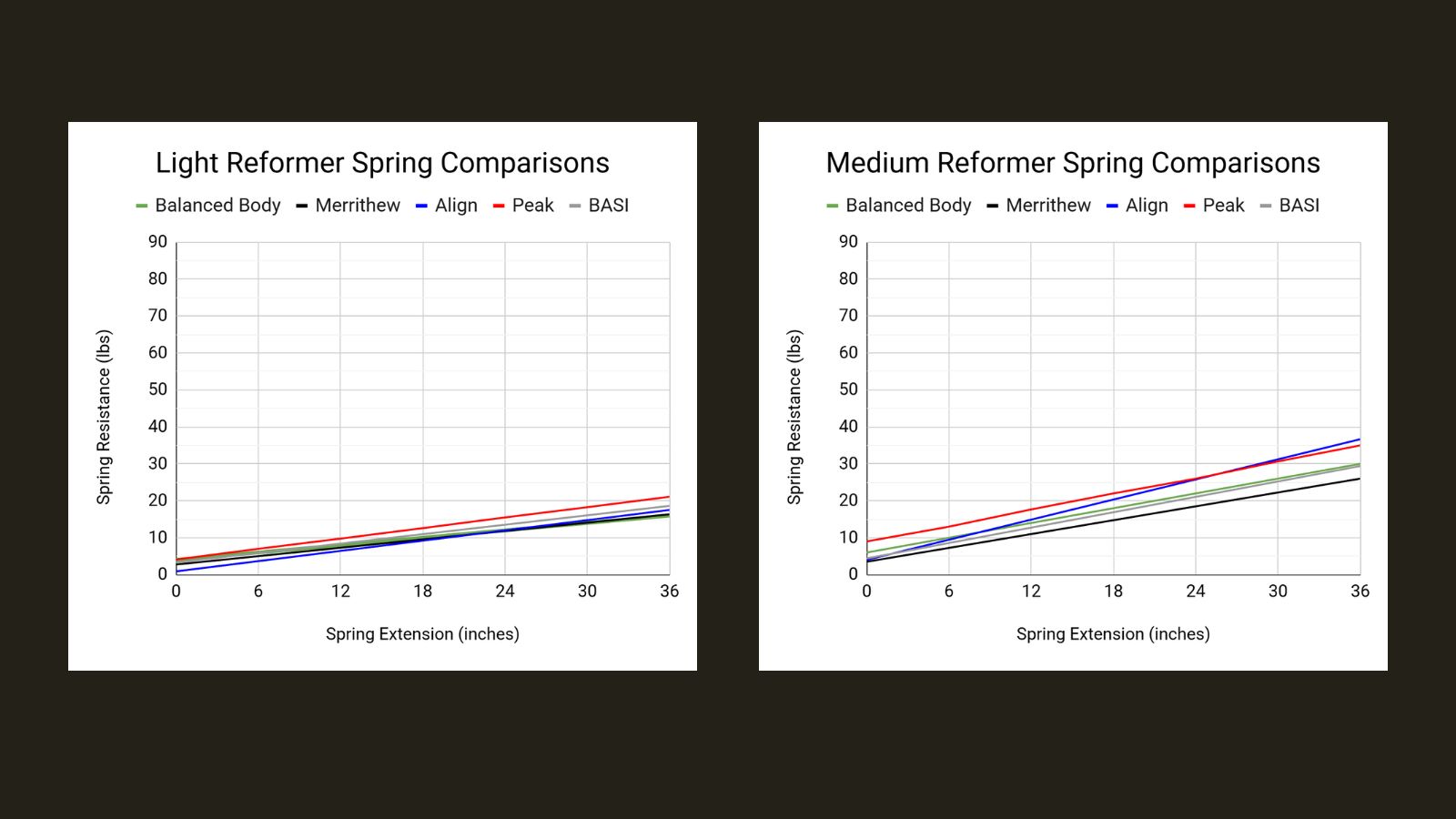
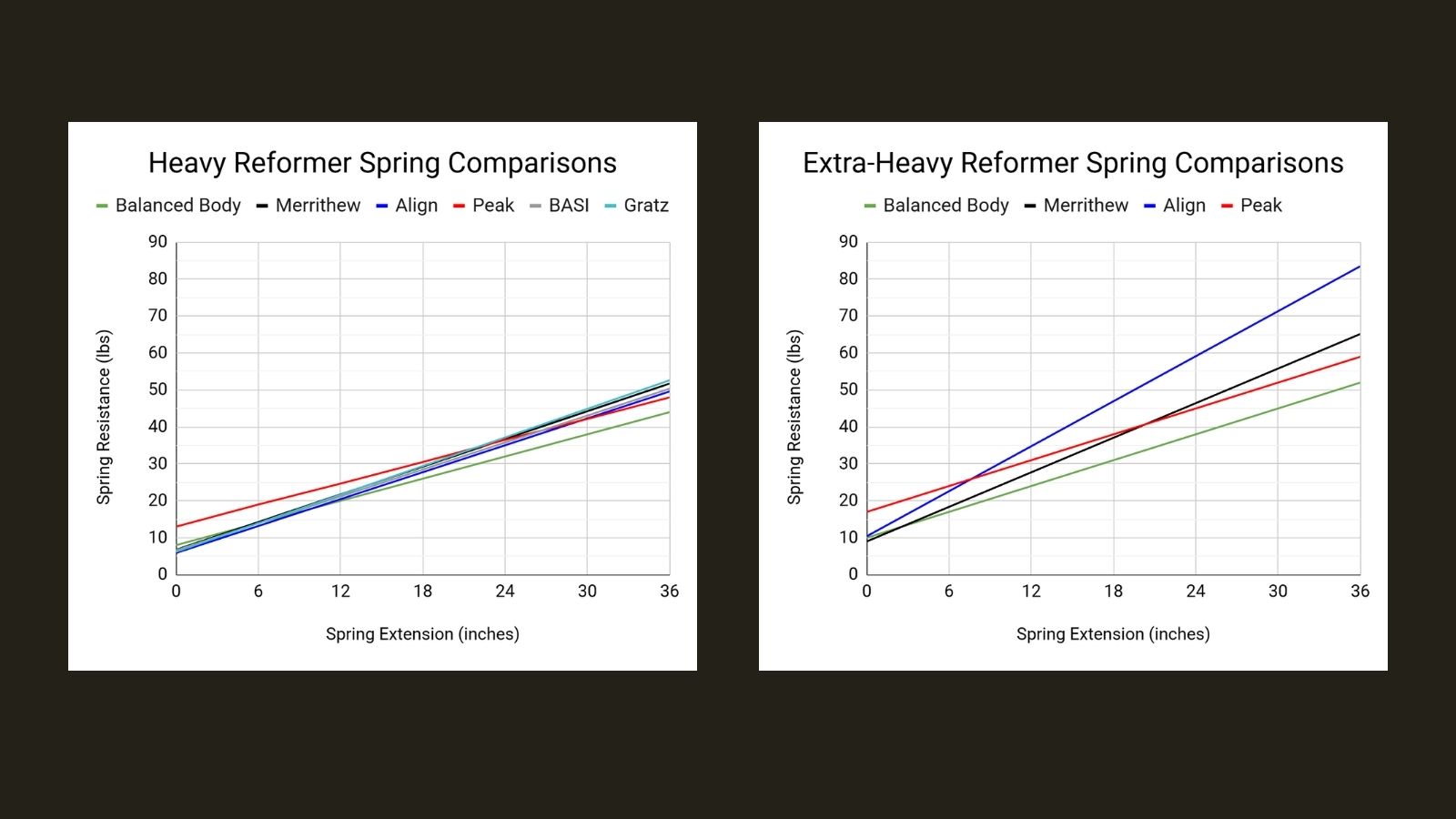
Some are close, some not so much! Pretty wild.
So what good is a conversion chart?
People always want the cheat sheet. "What is a Balanced Body red on a Merrithew?" So here is a conversion chart that lines up roughly equivalent springs across brands.
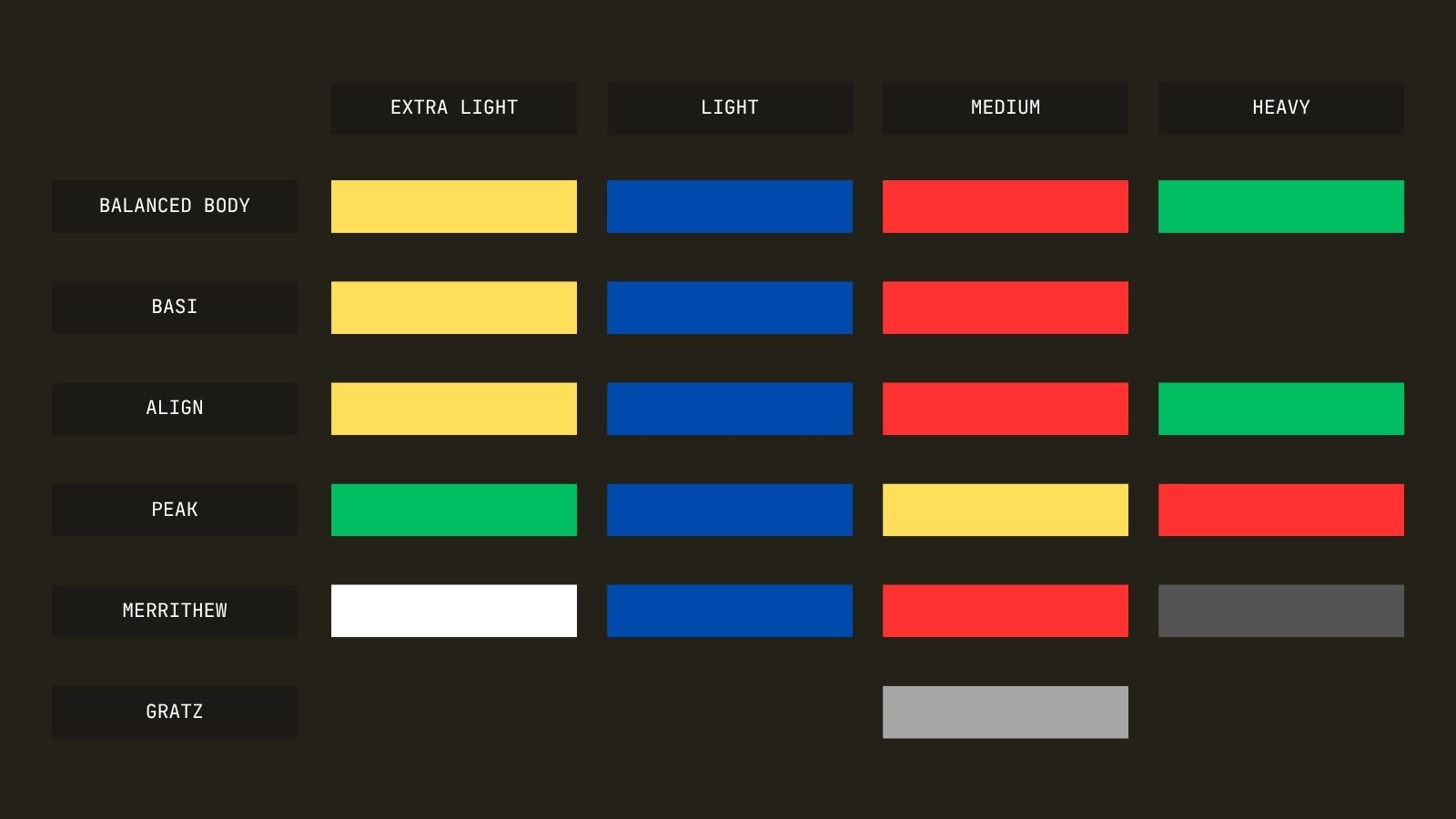
Use it. It is genuinely helpful for getting in the ballpark when you switch equipment. But know what it is. A starting place.
You must experience the movement on different machines before teaching it. Simply memorizing spring equivalents is not enough.
Even if you put the exact same springs on two different reformers, your clients will not feel the same thing.
Go back to the model: Force = k x + b. Identical springs fix k and b. But force also depends on stretch, and stretch is set by the machine dimensions and the client dimensions, not the spring.
Factors like how far the carriage sits from the spring bar at home, rope length, pulley height, footbar height/angle... all of it changes how far a given movement actually stretches the spring. A classical Gratz and a contemporary Balanced Body reformer with the same springs can stretch the springs different distances, landing you at different points on that climbing line. Same spring. Different load.
And my favorite example, even on the same machine with the same springs, two clients of different sizes will stretch the springs different amounts! I made a model of a 5'11" person (Rose) and a 5'1" person (Andrea) doing footwork. And on the same springs Rose stretched the springs 20 inches and Andrea stretched the springs 13.5 inches. That resulted in a 21 lb difference in max spring load they experienced! On the same springs!
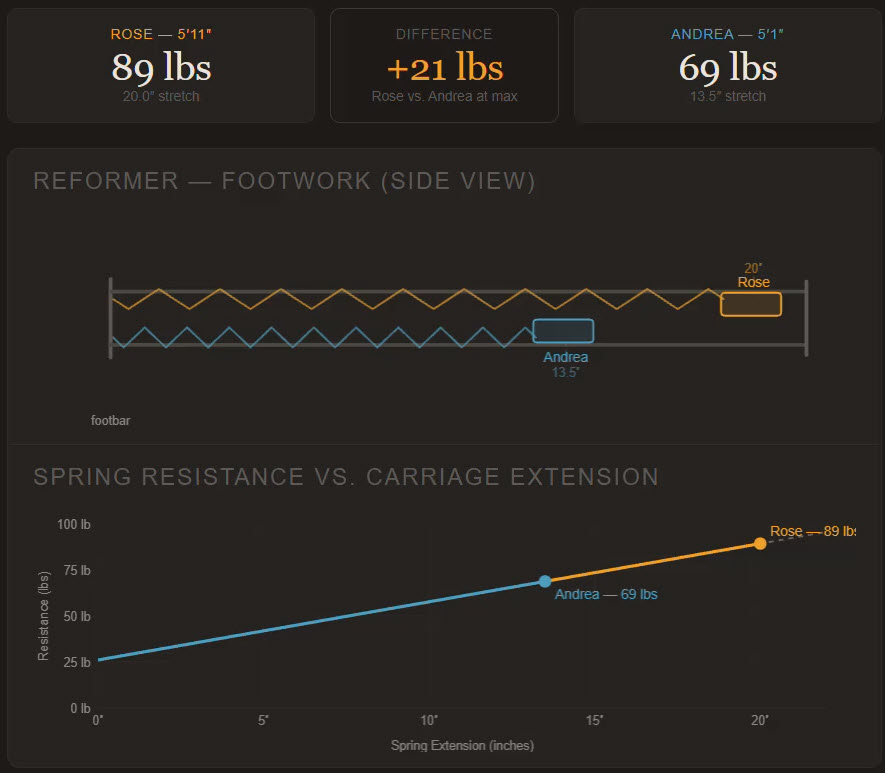
That is why you cannot teach from the spring setting alone. The setting is one input. Machine geometry is another. Rope length is another. Footbar and pulley height are others. If all you know is "two reds," you know one variable out of many and you are guessing at the rest. Understanding how each of those settings moves a body along the spring's force curve is the actual skill, and it is most of what the rest of this course is about.
My physics-based framework
So how do you teach different people, much less on different equipment? I cover a physics-based framework that teaches how to understand the load applied to your clients in my Physics 101 and Physics 102 courses. The next live, virtual workshops are coming up soon. Learn more here.